Sparrows
The Dark HalfSparrows begin as real, familiar birds and as the sound of a childhood medical symptom; as they repeatedly return around Thad Beaumont and George Stark, they become a flock with apparent agency in the conflict. The novel’s decisive turn is to identify them as psychopomps—guides between the living and the dead—and to make their arrival, rather than any human command, the means of Stark’s removal.
Ordinary birds and an old symptom
Before the supernatural events, Thad’s headaches were commonly preceded by a phantom sound he alone could hear, like the distant chirping of many small birds. Sometimes he imagined seeing sparrows gathered on wires and rooftops. A brain operation ended that particular symptom: the phantom chirruping did not recur in its immediate aftermath. Decades later, its return therefore links the present danger to a bodily history Thad had long regarded as finished.
The contrast between imagined and actual birds is important from the start. At George Stark’s apparent grave, Steven “Digger” Holt hears a sparrow scold him and welcomes the ordinary sound, distinguishing it from the hole in the ground he is investigating. A real bird can be merely present in the landscape; the later flocks acquire significance because their appearance coincides with Thad’s returning auditory experience and with Stark’s emergence.
The returning sound and written phrase
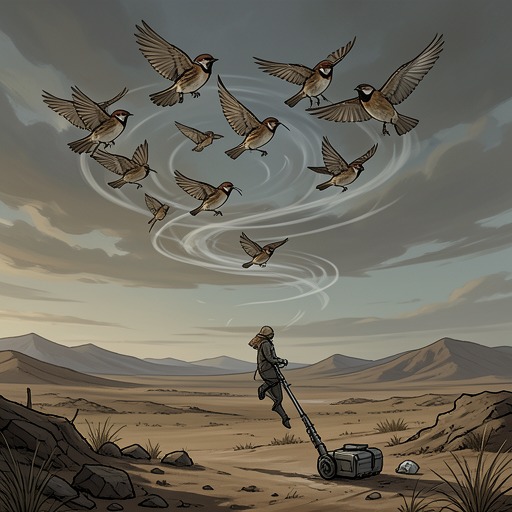
While reviewing pages of his new novel, The Golden Dog, Thad hears the phantom chorus again. This time the sound is accompanied by a vision: immense numbers of sparrows massed on rooftops and telephone wires, then rising together until they darken the spring sky. In the midst of this episode, his hand writes the words “THE SPARROWS ARE FLYING AGAIN.” He later repeats the phrase to himself without understanding it, and asks whether it means anything. At this stage, the sentence is a clue without an explanation, attached both to the birds and to Thad’s involuntary writing.
Thad understands the earlier episodes medically. He explains that his childhood tumor was accompanied by an auditory sensory precursor: not the more common smells associated with such symptoms, but birds—specifically sparrows. That account gives the sound a plausible bodily origin, but it cannot by itself explain the flocks that appear in the present or the events connected to Stark. The novel holds those possibilities together before increasingly treating the birds as more than a symptom.
The phrase returns with a changed force when Stark warns Thad that the sparrows are flying again. Outside, a vast flock crosses the sun and darkens the day. The birds now accompany Stark’s threat against people around Thad, so the recurrence is both warning and sign of his expanding danger. Later, when Thad suspects that some part of himself witnessed Stark’s actions and may have written about the sparrows, the birds also become evidence of a connection between the two men that exceeds ordinary distance and memory.
Flocks, visions, and apparent agency
The birds repeatedly appear at moments when Thad’s consciousness changes. In his university office, their cries begin as isolated sounds, gather into a deafening chorus, and accompany another episode of automatic writing in which he is unaware of his actions. Elsewhere, their presence is visible to others: during a night when Thad mutters in his sleep, nine sparrows sit on a telephone line outside his window, and more join them. When they take flight together at an unusual time, the scene links the flock’s movements to Thad’s experience without reducing the birds to a sound inside his mind.
The scale of their appearances grows. Sparrows line rooftops and wires, gather on a carriage-house weathervane, and occupy the ordinary fixtures of a town, including trees, parked cars, and a mailbox. During one episode, birds crowd the windows of Thad’s study while he falls into a seizure-like state. Afterward he sees two dead sparrows on the path below the study, then wonders whether he called them or created them. He believes that they will return. This uncertainty leaves open the precise boundary between his influence and theirs, even as the flocks become increasingly difficult to treat as private hallucinations.
Thad eventually encounters the birds as a collective presence that appears to answer him. At Gold’s Junkyard and Auto Supply, hundreds or perhaps thousands of sparrows gather among the vehicles; Thad quietly asks them to find George Stark. In his mind, he hears their response identifying him as owner, bringer, and knower. The flock then rises and flies toward Castle Rock, while the crawling sensation associated with Thad’s episodes returns. The sequence suggests that he can appeal to the birds, but not that he possesses uncomplicated command over them.
Psychopomps and the limits of control
Rawlie DeLesseps supplies a folkloric interpretation from Barringer’s Folklore of America. He explains that sparrows, like loons and whippoorwills, are considered psychopomps: creatures that conduct souls between the living and the dead. In the account he quotes, loons and whippoorwills gather near an approaching death, whereas sparrows are more ominous, serving as outriders of the deceased and guiding lost souls back into the world of the living. Rawlie calls them harbingers of the living dead. This distinction makes the sparrows’ connection to Stark especially pointed: he is not simply a living antagonist, but a figure who has returned from what should have been his grave.
The folklore does not turn the birds into obedient instruments. When Thad travels through the junkyard, sparrows remain where they are, watch him, and then depart together in the direction of Castle Rock. Their imagined response emphasizes his relation to them, but also assigns the flock its own perspective. Later, the road ahead is so full of birds that Thad wonders how he can reach the house; he thinks of the psychopomps as a danger if Stark should gain control of them. Their gathering seems to have a purpose, yet the evidence does not make that purpose fully available to human command.
Near the final confrontation, the birds assemble in numbers and their rustle swells into a roar. Thad writes “PSYCHOPOMPS” on a blank sheet, circles it, and places “THE SPARROWS ARE FLYING” beneath an arrow. The act joins written language to the interpretation Rawlie has offered: the recurring phrase is no longer only a puzzling symptom or omen, but a name for the birds’ role in what is about to happen.
Escort and narrative significance
At the climax, the sparrows serve as Stark’s escort back to the land of the dead. The thing that had been George Stark rises on a cushion of birds and is carried toward the large hole in the office wall. Their arrival completes the connection between the childhood signal, the phrase written during Thad’s trances, and the antagonist’s final fate. The birds do not merely forecast death; they participate in the removal of a being whose existence has crossed the boundary between fiction and life, and then life and death.
The flock’s function is therefore both symbolic and material. It bears the meaning of Thad’s old symptom and the story’s repeated warning, but it also acts in the physical world, assembling, flying, orienting itself toward Stark, and carrying him away. Its recurring presence unsettles the distinction between medical explanation and supernatural event without making those explanations interchangeable. By ending with the sparrows as guides rather than possessions, the novel places a limit on human mastery: Thad can call, interpret, and write about them, but their final work belongs to a force beyond his control.